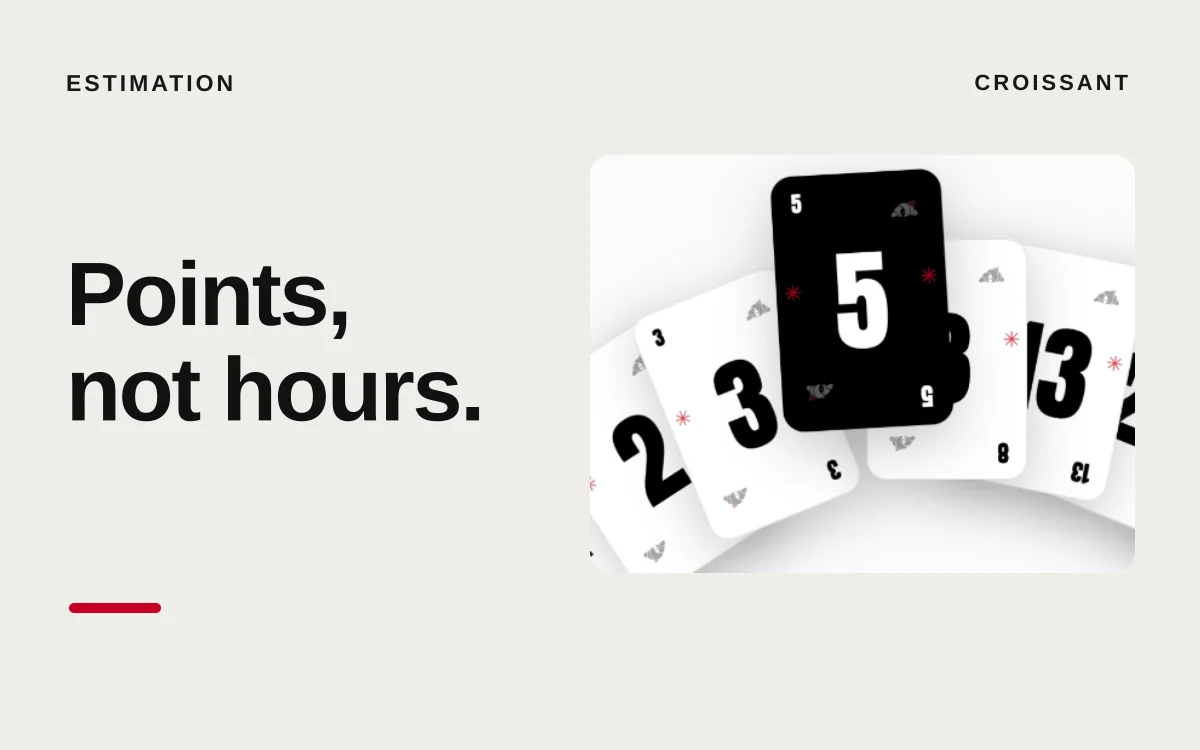
Story points tell you whether one piece of work takes more or less effort than other stories your team already knows. They are not a time unit. When everyone converts them to hours in their head, the exercise stops working, and Planning Poker spreads become harder to read.
This is a team convention, not a Scrum rule. The Scrum Guide does not define story points. Teams use them because relative size is easier to agree on in refinement than a calendar promise.
Why not hours
Hours feel honest. They also assume you know who does the work, what else is on their plate, and that nothing around the story will move. You almost never know that in refinement. You know whether this looks bigger than the password reset you shipped last month.
Points keep the conversation on relative size: complexity, volume of work, and uncertainty, compared with stories this team has already finished. They are not a promise to a calendar. Velocity (how many points you usually finish in a sprint) is a later conversation, and it only means something if the points stayed comparable.
If a stakeholder needs a date, give a date from a forecast, not from “8 points × 4 hours”. Mixing the two is how a team starts sandbagging every card.
A reference story
Calibration is not a workshop with sticky notes. It is one story everyone remembers.
Choose something the current team actually shipped. Small, boring, complete. “Forgot-password email, no new provider, no copy rewrite” is a good 3. “The rewrite of checkout” is a terrible 3.
Write it down. Put it at the top of the board. For the next few sessions, every other story is smaller than that, about the same, or clearly larger.
If half the room was not there when that story shipped, tell the story in one minute before the first vote. A reference nobody shares is just a number on a wall.
You can change the reference when the team or the product changes a lot. Do it on purpose, once, and say so. Quietly sliding the 3 toward bigger work is how points inflate without anyone admitting it.
Compare stories
You are not looking for the true size of the story. You are looking for a bucket the team can share.
Useful questions, in this order:
- Is it in the same neighbourhood as the reference, or obviously not?
- What is the extra work if it is bigger: more surface, more unknown, more coordination?
- What would have to be true for it to be smaller?
Useless questions:
- How many hours is an 8 for you?
- What did the other squad give this?
- Can we do 6 because 5 feels low and 8 feels high?
- Password reset email
- SSO with the current provider
- Billing provider migration
On a real board it looks like this. Resetting a password email is a 3: known path, one service, tests you have written before. Adding SSO with a provider you already use is an 8: more moving parts, but the shape is familiar. Migrating billing to a new vendor is a 13 until you split it. Too many departments, too many “we’ll see”.
The point of the three numbers is not accuracy. It is that nobody in the room will confuse the email with the billing migration next Tuesday.
What breaks calibration
These habits make the numbers stop meaning the same thing from one sprint to the next.
Translating to hours in the room. “8 is two days.” After that, juniors and seniors are not estimating the same object. They are estimating their own calendar.
Comparing teams. Squad A’s 5 is not Squad B’s 5. Different codebases, different guts. Cross-team point reports look precise. They are not.
Changing the deck mid-stream without resetting the reference. If you used to have 6 and 7, and now you only have 5 and 8, old 8s and new 8s are not the same conversation.
Padding because last sprint slipped. The story did not get bigger. The team got scared. Put the fear in the risk, or split the work. Do not invent a 13 that means “please do not yell”.
Estimating bugs, chores, and projects on the same scale without saying so. A production incident is not a feature. If you point it, say that a 3 here is “short, known, contained”, not “same as the password email”.
New people, old numbers. A team that turned over in March should not treat January’s velocity as law. Recalibrate. Pick a new reference. It takes one session, not a quarter.
When votes spread
Points only help if the room can stand a disagreement.
When the cards come up close (5 and 8, 8 and 13), pick one after a short why. Neighbouring values mean “we roughly see the same story”. Locking the higher one is a reasonable default when the unknown is real.
When the cards come up far (3 and 13), stop talking about points. Talk about what each person included. You will usually find a missing constraint, or a story that wants to be two stories.

Camille

Alex
There is a longer version of that conversation in the facilitation guide. The Fibonacci gaps that make 8 and 13 feel far apart are covered in why teams use that scale.
Do not lock a number to end the silence. A skipped story is a better artefact than a point everyone distrusts.
If you want to run that comparison with hidden votes, open Croissant and put the reference story first. The scale does not care which tool you use. The team cares that the first card is one they already understand.